Perspectives
Short essays on the commitments behind market entry, industrial relationships between India and Italy, the role of research in commercial judgement, and how engineering partnerships change as design tools accelerate.
Read the first essay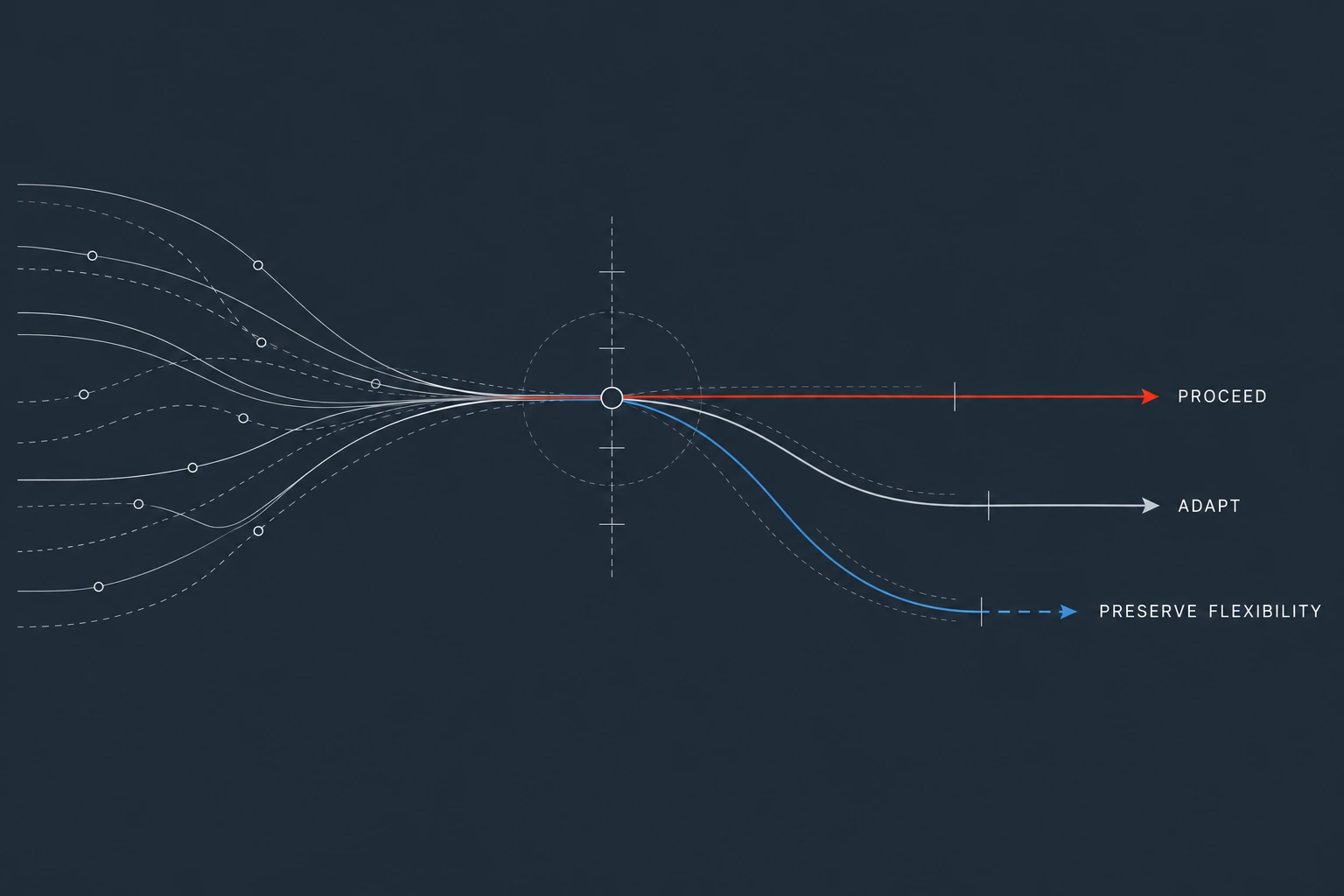
Market entry commits the enterprise
Expansion creates obligations that outlast the first sale. Representation, technical responsibility and access to the customer decide how much control a business keeps over its proposition, and for an owner-led enterprise they also carry a reputation built over years.
A local counterpart can speed access while concentrating knowledge of the customer and responsibility for service. Scrutinise that dependence before it becomes hard to change.
A sound assessment makes the commitment explicit: the resources required, the responsibilities retained and the conditions for further investment.
Industrial alignment sustains the relationship
Bilateral access opens a conversation. Durability depends on how the businesses work together: technical expectations, programme discipline and willingness to carry responsibility when an application becomes demanding.
In specialist automotive and motorsport, technical fit still needs commercial alignment. Different expectations of volume, support or development pace change the resources each side can justify.
Research before engagement should reveal this operating fit, so leaders can judge whether the relationship is worth pursuing and what must be resolved first.
Intelligence must remain useful under uncertainty
An entry plan rests on assumptions about demand, counterpart capability and the continuity of a route. Shifts in trade conditions or geopolitical priorities can change their weight even when the product stays relevant.
Agentic infrastructure retains the evidence and rationale behind an assessment, so a new development can be read against the original reasoning.
The value lies in knowing which developments warrant action. Experienced people still choose whether to proceed, adapt or keep options open.
When Dallara’s design loop shrinks from days to minutes, where does India fit?
On 30 April 2026, IBM and the Dallara Group announced a collaboration on physics-based AI models for aerodynamic design (IBM newsroom release ↗). Dallara works from Parma, in Italy’s Motor Valley, and is the sole builder of cars for IndyCar, Formula 2, Formula 3 and Super Formula, among other series. That makes the announcement worth reading closely for anyone in the India–Italy corridor who works on how race and performance cars are engineered.
The early results are specific. One model was trained on Dallara’s own validated aerodynamic data. On a conceptual LMP2-like car, the two companies ran several rear-diffuser configurations through conventional CFD and through the new method. CFD took a few hours; the model took about ten seconds, picked the same optimal design and showed broadly similar error margins. Across the hundreds of configurations in a typical design set, the companies suggest days of simulation could become minutes. The work is described in an arXiv preprint dated 20 April 2026 and builds on an IBM model called GIST. The companies also mention early exploration of quantum computing, which is a longer horizon.
These are early findings, reported by the companies, on a conceptual geometry. They deserve attention without being treated as settled. The more useful question for a corridor is not how fast the tools become, but where value moves when early screening gets cheap.
Three things look set to become scarcer. The first is validated data: the model learned from Dallara’s data, and the next step the companies describe is adding wind-tunnel and track measurements. The second is physical validation capacity: tunnel time, track test programmes and the discipline of correlating simulation with reality. The third is people: engineers who can tell when a fast model can be trusted and when to return to full CFD. IBM describes the approach as speeding up workflows while keeping the underlying physics, which puts the engineer’s judgement at the centre rather than at the edge.
For an Indian engineering or simulation firm whose offer to European clients rests on solver hours, the question is direct: what happens to that offer when a few hours become ten seconds? The answer may lie a step up the chain, in data preparation and curation, correlation and validation work, and engineers fluent in both fluid dynamics and machine learning. Whether Indian firms are already building those capabilities at depth is worth asking each prospective partner directly rather than assuming.
For an Italian team or specialist supplier without an IBM-scale partnership, a different question arises: who can help structure, validate and extend its own data so that these methods become usable? A partner in India could bring engineering depth and a working day that starts a few hours ahead of Italy’s. The terms matter as much as the talent. Who owns the training data and any model derived from it? How are results checked against tunnel and track? Can the partner’s engineers explain where a model is likely to fail?
None of this replaces the wind tunnel, the test day or the experience of people who have run cars at the limit. It changes the order of work, and with it the shape of a good partnership. Dallara’s chief executive, Andrea Pontremoli, put racing’s lesson simply: “you either win or are forced to learn.” The India–Italy relationships worth building now are the ones designed to learn together on validated data.
If you are an Indian engineering firm weighing a Motor Valley relationship, or an Italian team looking for a partner in India, Paddock Introductions is where that conversation can start.
Strada is Prabha Shankar’s personal practice: one corridor, India ↔ Italy, and one sector, motorsport and premium and performance automotive. For mobility, new energy or data centres, Prabha works through Fractionova, the company he founded.
Visit Fractionova